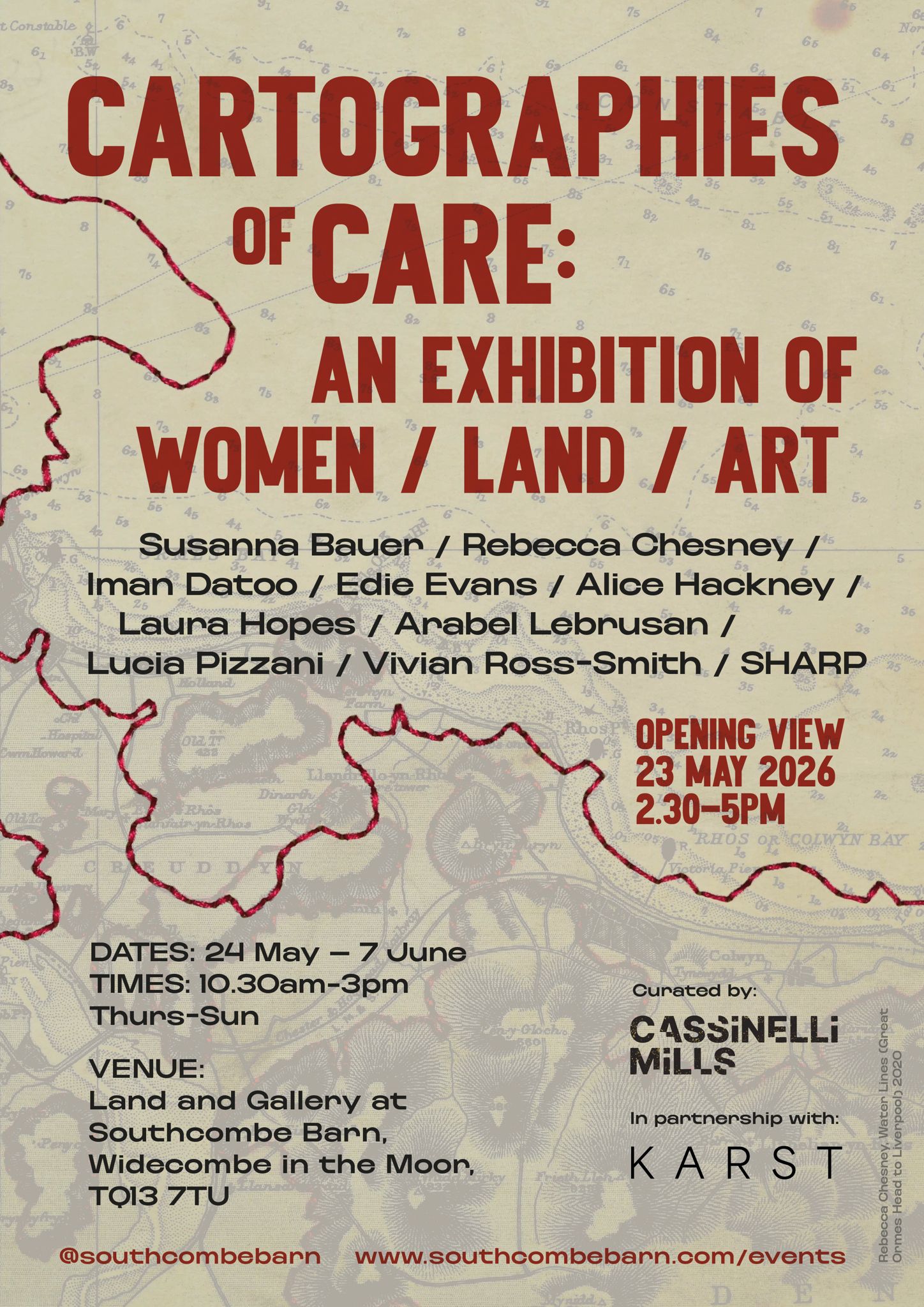
Cartographies of Care
24 May – 7 June only, Southcombe Barn, Dartmoor
In partnership with KARST
How much longer will we have these lands to care for? In the current crises contexts of warfare and rising sea levels, this exhibition explores gender and ecology through the everyday and peripheral encounters of artist-women and non-binary artists with land and landscape. By positioning care as a cartographic practice, the exhibition challenges dominant spatial histories and foregrounds intimate practices we have with the land. Cartographies of Care offers landscapes not as monumental conquests, but as relational fields shaped by bodies, memory and lived experience. The artists invite viewers to consider how landscapes might be held by humans rather than mastered, and how art can cultivate forms of ecological relation rooted in attentiveness rather than assertion.
The exhibition links together the multifaceted practices of ten artists offering expanded conversations in women’s experiences of, relationships with, and approaches to, land. Rebecca Chesney, Iman Datoo, and Arabel Lebrusan engage land as a politicised and contested site, foregrounding how ecology is entangled with power, extraction, and social histories through research-led and site-responsive approaches. Susanna Bauer, Edie Evans, and Laura Hopes centre practices of care, repair, and reuse, working intimately with found and foraged materials to explore themes such as fragility and craft traditions. The practices of SHARP, Lucia Pizzani, Vivian Ross-Smith and Alice Hackney offer embodied narratives told through ancestral and personal histories and situated experiences.
Through intimate acts of walking, gathering, tending, storytelling, drawing, research, craft practices and speculative and deep mapping, these artists produce alternative geographies placing land and art through feminist, decolonial and ecological lenses that centre the ‘margins’ rather than the monument. Care becomes both method and politics: a way of knowing land through sustained attention and responsibility, mapping obscured experiences with land, in place of dominance and destruction over vast terrains.
With special thanks to Tilly Craig for research and curatorial support.
Programme Details:
- Opening View 2.30pm on Saturday 23 May 2026. Free Entry
- Exhibition text by Prof. Vron Ware
- Special one-off screening of Vivian Ross-Smith’s Refinishing (2025) Saturday 23rd May 2026, 2.30-5pm only
- New commission by Alice Hackney
| Exhibition | 24 May – 7 June, | |
| Opening Times | Thurs – Sun, 10.30 – 3pm. | |
| Address | Southcombe Barn | |
| Widecombe in the Moor | ||
| Dartmoor | ||
| Devon | ||
| TQ13 7TU | ||
| Contact. | 07886 083473 | |
| cassinellimills@gmail.com @cassinellimills | ||
Cartographies of Care takes place in partnership with KARST gallery, coinciding with Faunal Succession: Lucia Pizzani, a solo exhibition touring to Focal Point and Mostyn. Cartographies of Care includes the Southcombe Barn Open Call Awardee Edie Evans, recipient of the Women/Land/Art Residency, as well as Open Call finalists, Susanna Bauer, Alice Hackney and Vivian Ross-Smith.
Artist Bios
Bauer works with natural leaves and crochet, creating an intimate dialog with nature. Found leaves are repaired, embellished and combined using handmade lace crochet – a laborious traditional technique relying on tension, set in direct relationship to the fragile natural material. The resulting forms are a meditation on the beauty and intricacy found in the natural world and a reflection of complex and tender relationships both within ourselves and our environment. Working on an unusually detailed scale with very fine hooks, needles and thin cotton threads, Bauer pushes crochet to its very limits. In some projects she creates intricate lace patterns directly onto the edges of single leaves, in others Bauer uses crochet sculpturally to reshape, join, mend or extend the leaves to compose pairs, groups and sometimes whole branches. Looking closely at a leaf, its uniqueness becomes apparent. Varied in tone, size and shape, no two leaves, even coming from the same tree, are ever the same, each carrying its own individual network of veins like a fingerprint. After training in landscape architecture, Bauer spent 17 years working as a modelmaker for film and advertising. She studied at Camberwell College of Arts and has been creating work with leaves and thread since 2008. Bauer’s work has been exhibited in the UK, USA, Sweden, Italy, Germany, The Netherlands, Switzerland, Hong Kong, South Korea, Japan and India. It is held in private and public collections and has been featured in numerous international publications and a tri-lingual monograph.
Long interested in the climate crisis Chesney’s rigorous and quiet research-led practice explores human interactions with land including bio-diversity loss, rising sea-levels, air pollution, labour and class. Chesney’s work examines our complex relationship with land and nature, by engaging with issues of culture, politics and power. Chesney uses many methods to gather information: visiting archives, utilising open source data, talking to community members and documenting flora and fauna through sound, video and drawing, with the results taking the form of installations, interventions, maps, walks, and creating large scale living sculptures in the landscape. In 2025 Chesney was a recipient of a Henry Moore Foundation Artist Award and her work was acquired for the Government Art Collection. Upcoming and recent exhibitions include Rebecca Chesney and Lubaina Himid:
Ushaw Historic House, Saturday 14 November 2026 – Sunday 31 January 2027; commissions for the
Harewood Biennial (2024) in collaboration with the British Textile Biennial (2023); Hestercombe
Gallery, Somerset (2023); HOME, Manchester (2023); Super Slow Way, east Lancashire (2022); and TONSPUR Kunstverein Wien, Austria (2021). Chesney was Visiting Artist at Yorkshire Sculpture Park in 2021 and awarded a Lucas Artist Fellowship to Montalvo in California, USA (2016-18).
Iman Datoo is a transdisciplinary artist and researcher based in Cornwall. Her practice investigates the world-making capacities of plants, soils and people – how we move, behave and make place. Working through video, claywork, scoring, installation and performance, she crafts situated projects that move through the real and the imaginary: forming liminal worlds where new values and ways of being are practiced and improvised through stories of repair. At the centre of Iman’s work is “kinnomics”, a transitional framework that shifts thinking away from an economics of commodification toward making kin with those rendered inert, inanimate, or marginal – whether pathologised soils in mines, invasive species in plantations, colonised specimens in botanical gardens, or artefacts held in museum collections. Through this lens, she foregrounds an intimate planetary existence in which the human is never at the centre but always embroiled in relation. Iman is currently undertaking an LAHP funded practice-led PhD between UCL’s Slade School of Fine Art and Bartlett School of Architecture, and serves as Head of Research and Community at Radical Ecology. In
2025, she was the Stonecroft Art in Residence with Agnes Etherington Arts Centre and Queen’s University Biological Field Station in Ontario, Canada, and a recipient of the Two Together Residency with Porthmeor Studios and the Freelands Foundation. Previous residencies include the Eden Project and University of Exeter’s Environment & Sustainability Institute (2023). Her debut solo exhibition Kinnomics opened at the Agnes Etherington Arts Centre in 2025.
Edie Evans is a multidisciplinary artist working at the intersection of ecology, neurodiversity, and materiality, with a particular focus on clay. She was recently recognised as Promising New Talent by the British Ceramic Biennial and was the Freelands Studio Fellow at Swansea College of Art
2024-2025. Upcoming solo exhibitions include Burton at Bideford Residency, July 2026; Trace / Fold,
Crypt Gallery London, 2025; Fragments, Freelands Foundation Studio Fellowship, Swansea, 2025;
Middle Ground, Bath, 2024. Recent selected group exhibitions include A Common Thread, Lethaby
Gallery, London, 2026; Menial and Trivial, BSU & Welcome Trust, Bristol, 2025; Legacy in Making, Somerset Rural Life Museum, 2026; Somerset Craft Guild & Somerset Art Works Exhibition, 2025 and Enfurl, Unfold, Freelands Foundation, London, 2025. Edie’s value-driven practice is rooted in sustainable, tactile processes that challenge traditional approaches to ceramic production. Her work moves beyond industrially processed materials, embracing found objects, foraged resources, and natural processes. As a neurodivergent artist, her embodied way of making is instinctive, slow, and deeply connected to place – often emerging through acts of walking, gathering, and intuitive transformation. This ongoing material dialogue extends to the stratigraphy of landscape, where layers of time, memory, and erosion are embedded within both earth and object. Her pieces serve as quiet testaments to the endurance and fragility of the natural world, while also functioning as records of lived experience and environmental interaction.
Alice Hackney cares about the connection between people and the landscapes that surround them. Working at the intersection of ecology, femininity and disability, she combines labour and precision with ideas of homeland and community to make herself a place within the systems around her. Her work weaves printmaking, performance, textiles, cartography and installation, frequently incorporating collections of found natural materials such as sheep’s fleece, feathers, wood and cuttlefish bones. She is particularly fond of ‘useless’ materials and subjects: the devalued sheep’s fleece, the pigeon – once prized for its homing abilities, and her own fatigued body. Hackney playfully and painfully reflects on the unhelpful and unnatural boundaries imposed on bodies and landscapes. Drawing on her childhood surrounded by sheep in rural Derbyshire, she collates her lived experience of chronic illness with discourses of land ownership, access, and usage. Hackney holds a First Class BFA in Fine Art from The Ruskin School of Art, University of Oxford (St John’s College) and a
Distinction from her Art Foundation at Manchester School of Art. She has undertaken residencies with
The Oxford Research Centre in the Humanities’ Art Biodiversity and Climate Network (2019-21), UK
New Artists (2022-3) and No Jobs In the Arts (2025). She is the current recipient of the Toby O’Brien
Bursary at Newlyn School of Art. She is also a Printmaking Tutor at the Bodleian Libraries and Christ Church, University of Oxford, and a Producer for Adults & Communities at Modern Art Oxford. She works both from her studio with Fusion Arts in Oxford, and her home in Charlesworth, Derbyshire.
Laura Hopes is an artist and researcher whose research focuses upon the relationship between land and people. She is interested in being a ‘vulnerable practitioner’, whose work draws upon multiple forms of knowledge. Her work is open to collaboration and acceptance of unknowns and often tries to use and reimagine byproducts, found archives or discarded materials. Through extensive collaboration within the collective Still Moving and with academics and experts in diverse fields, her expanded practice encompasses writing, conversations, film, performance, installation and multi-disciplinary exchange. Upcoming and recent exhibitions/projects include Lets SEA your Tatts with Low Profile 2026; Wild Exhibition, Royal Albert Memorial Museum; Remember Nature 2025: Calls to Action Tate Modern 2025,
Spanish-born, UK-based sculptor working across object-based, installation, and socially engaged practices, grounded in matter that matters and in sustained research into social history. Lebrusan’s work bears witness to the deaths of humans and more-than-humans shaped by war, extraction, gender violence, and systemic neglect. As a mother, migrant, and ethical goldsmith, she is attuned to loss, displacement, and the scars embedded in matter. Lebrusan transforms materials already marked by violence, such as confiscated knives or iron ore, into tactile forms that hold grief and potential.
Working between studio and site, Lebrusan treats matter as collaborator rather than resource. Through acts of transformation rooted in care, craft, and ritual, she creates spaces where memory, resistance, and resilience can be held in tension. Her work has been supported by Arts Council England and has been exhibited in the UK and internationally, including at The Higgins Art Gallery and Museum (Bedford), Brighton CCA, Standpoint Gallery (London), and Bermondsey Project Space (London). She held a Research Fellowship at the Centre for Spatial, Environmental and Cultural Politics, University of Brighton, and completed her MA in Sculpture at the Royal College of Art. Recent projects include Femicides, created during her residency at Quiet Down There, Brighton; and Blunt Blades, an ongoing body of work using the metal from police confiscated artefacts.
Pizzani’s practice involves the body and self and is always informed by materiality. One of the core concerns is the interrelationship between narratives of women in history and processes of metamorphosis in the natural world. Working across a variety of media – including photography, ceramics, videos, drawings, performances and installations. Having worked as part of the environmental movement in Venezuela for many years, Pizzani has always incorporated ecological elements into her artwork. Her work is part of the Tate Collection, the UK Government Art Collection and the ESCALA and Essex Collection of Art from Latin America (Colchester) amongst others. Her first institutional show in the UK will open at the end of March at Focal Point Gallery (Southend) and its touring to KARST (Plymouth) in June and Mostyn (Llanduno) in 2027. Prominent commissions and participations include the Vienna Climate Biennale (Vienna) 2025, the Harewood Biennial in
2024 (Leeds), Serpentine Galleries’ SEEDS programme, 2024 (London) and Palazzo Bolani for Planet B: Climate Change and the New Sublime in 2022 (Venice) curated by Nicolas Bourriaud. Her first monograph was published in 2024, a bilingual volume bringing together new texts by Nicolas Bourriaud, Lucia Pietroiusti, Torrivilla and an interview with Lisa Le Feuvre, under the editorial coordination of Natalia Valencia Arango. She is a studio artist at Gasworks.
Vivian Ross-Smith (she/they) is an artist working in a squishy place between care, ecology and tactility. Her site-specific performances, textiles and objects draw on queering practices and reflect their islander identity. Often, Vivian uses her practice to build community around an idea or place, seeking collaboration with other artists, rural communities, materials, and landscape. Born in Edinburgh and raised in Fair Isle, Shetland, Vivian holds a BA(Hons) from Gray’s School of Art (2013) and a Masters with Distinction from Glasgow School of Art (2020). They were the inaugural Freelands Studio Fellow at Swansea College of Art (2023). Vivian works as part of South Wales performance collective, SGÔR.
https://www.vivianrosssmith.com/ https://www.instagram.com/vrosssmith/
SHARP is a queer, working class, socially engaged artist, activist, producer whose interdisciplinary approach moves between experimental video, photography, sculpture, and sound installations. SHARP researches and explores the human condition through a queer lens, focusing on issues around gender, sexuality, and social commentary. Their work stems from photography and an extensive archive of imagery that dates back to the 80’s, from this anchor point they have expanded into video, installation and sculptural intervention as a means to occupy space. SHARP’s works originate from a vital urge to document their own life, their butch identity and the spaces around them, be they domestic or out in the natural landscape in order to illuminate the shadow left by section 28 and provide an inter-generational connection with repetitions in histories that continue to infringe on the liberties of LGBTQIA+ people. SHARP has works held in national public and private collections. They were awarded a Henry Moore Foundation Artist Award 2025 and was the overall award winner of the Exeter Contemporary Open 2024. Previous exhibitions and performances include Leeds Art Gallery, Bradford City of Culture, Alice Austin House New York, Yorkshire Sculpture Park, Newlyn Art Gallery,
Manchester Art Gallery, The Whitworth, Deptford x festival London, The Gallery 78 in Reykjavik Iceland, VOID Derry and HYPERLOCAL festival Buenos Aires. Together with Ro Robertson, SHARP is the custodian of To Moor The Sun, the women’s land in West Penwith Cornwall.
_________________________________________________________
About Cassinelli Mills
Cassinelli Mills go beyond traditional artist representation, committed to supporting artist-women and non-binary artists past, present and future. We support artists with a patchwork approach, from grant applications to academic recognition, from disability access to sales. With distinguished art historian and Holberg Prize awardee Prof. Griselda Pollock as our patron we are committed to countering the canonical structural disparities artist-women face. Cassinelli Mills is a collaboration between Vashti Cassinelli, an independent curator who runs @southcombebarn arts space in Dartmoor and Dr Ella S. Mills, an independent art historian, curator and artist mentor of @talking_on_corners. We support the living legacies of early-career to established artists, whose practices are grounded in research and often focus on cross-temporal connections. We are committed to working with artists whose work is socially engaged and who encourage human connections.
KARST is an independent contemporary gallery and artists studios in the South West, recognised internationally for dynamic creative programming. Situated in Plymouth’s Stonehouse, our ambition is for everyone to have the opportunity to engage with, participate in, and experience contemporary art. We create space for taking risks and opportunities for artists and curators to provoke, disrupt and innovate. KARST is an Arts Council England National Portfolio Organisation.
_________________________________________________________
Further work by Arabel Lebrusan at arabellebrusanart.com/artworks/ and arabellebrusanart.com/arabel-lebrusan-visual-artist-and-sculptor/